home

The Company

Products

References

Publications

Order


From Am J Roentgenol 129:215-220, August 1977:

Evaluation of a New Transthoracic Needle for Biopsy of Benign
and Malignant Lung Lesions

ANTHONY J. S. HOUSE AND KENNETH R. THOMSON

The results of 88 traristhoracic needle biopsies of lung lesions using the Rotex Screw Needle Biopsy Instrument ® are analyzed. Of 57 mallignant lung lesions, 55 were diagnosed correctly. Two patients with false negative biopsies had technically inadequate examinations. All but one of the 28 benign lung lesions were correctly diagnosed as nonmalignant. One false positive diagnosis of malignancy was made. The occurrence of complications was similar to those reported for conventional fine needle aspiration. The high accuracy rate is attributed to the effectiveness of the Rotex screw needle biopsy instrument in sampling the lesions and to the use of biplane fluoroscopy.

Introduction

In most developed countries bronchogenic carcinoma is the commonest malignant tumor in males, and its frequency in females is rapidly on the increase  [1]. The overall 5 year survival rate is only 5%-7% [1-3]. Asymptomatic patients with small  peripheral well differentiated tumors have the best prognosis, with 5 year survival rates   approaching 50% [4-12]. The operative mortality following thoracotomy is less than 1% for  patients under 35 years [13,14] but can rise to 6%-7% [6, 7] in older age groups. In patients found to have nonresectable disease, the mortality may reach 9.3% [15]. A certain  postoperative morbidity can also be expected. Thus accurate assessment of the patient's disease prior  to thoracotomy is desirable. Since only 40%-50% of all small peripheral pulmonary nodules  which come to surgery turn out to be malignant [13, 16, 17], a number of presurgical biopsy  techniques have been developed. Indirect bronchoscopic brush-forceps biopsy of these lesions has  a low diagnostic yield [18-20] Bronchial brush biopsy under fluoroscopic guidance results in a   significant improvement [20- 25], but the yield is still only 60%-70% for small peripheral  carcinomas [19,22, 24]. The accuracy can be further improved when a biopsy forceps or curette  is used [21, 24-28]. Percutaneous aspiration biopsy is currently the most accurate  technique. High diagnostic yields can be achieved [20, 23, 29, 30-32]. An accuracy of around 98%  has been reported for small (less than 2cm) peripheral cancers [31]. False negative biopsies  in general range from 5%-i 5% [30], but results as low as 2% have been achieved [3l]. Positive  identification of benign lesions is difficult with the aspiration technique; diagnosis of a benign   lesion is usually made by excluding malignancy [29, 30].
In our department fine needle aspiration biopsy has been used since 1971 with an 11% false negative rate for malignant lesions [23]. Since late 1974 we have  used the Rotex Screw Needle Biopsy Instrument ®   (Ursus Konsult AB, Arsenalsgatan 4, S-111 47  Stockholm, Sweden) as described by Nordenström [33] in an attempt to improve the  diagnostic yield. This report compares our results using this new needle with the conventional  fine needle aspiration technique.

Materials and Methods

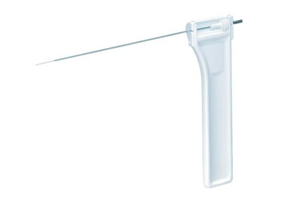
The Rotex screw needle biopsy instrument [33] consists of a 1.0  mm diameter stainless steel cannula 160 mm long, with a cutting edge at its tip and a plastic   radiolucent head (fig. lA). A stainless steel needle (fig. lB), 0.55 mm in diameter and 195 mm  long is inserted into the cannula (figs.lC and 1D).The distal 16 mm has been designed so  that it resembles a screw (fig. ic). The transthoracic needle biopsy technique has been well  described [29, 30]. The patient fasts for 4 hr preceding the procedure and is premedicated with  Valium, codeine, and atropine intramuscularly. Depending on the position of the lung lesion and  its relation to the interlobar fissure, the patient lies on the fluoroscopy table either supine  or prone. Although single plane fluoroscopy is satisfactory, in our experience biplane viewing  adds convenience and accuracy. Small lesions may be difficult to locate in the lateral plane.  They can usually be seen if lateral tomography is used to pinpoint the position of the lesion prior  to fluoroscopy. After fluoroscopic localization of the lesion, the patient's skin is  carefully cleansed and the puncture site is anesthetized (1% lidocaine) down to the parietal pleura.  A fine scalpel blade is used to make a skin puncture. The screw needle is positioned within the   cannula so that it is aligned with the cannula tip. The instrument is then held with a pair of  15 1/4 cm Kelly straight forceps, to which rubber tips have been attached to enable a secure grip.  Under frontal fluoroscopy, it is advanced to the estimated depth of the lesion and the position  checked on lateral fluoroscopy. If possible, the instrument tip is positioned in the uppermost  portion of the lesion. The screw needle is then rotated clockwise with slight forward pressure  down through the lesion for a distance of about 1.5 cm. The cannula follows, advanced   counterclockwise to the same depth so as to enclose and protect the material which has been collected  around the needle. After rapid removal of the instrument, the spiral portion of the screw needle  is pushed out of the cannula and a sample obtained by passing it between two glass slides. A  second and, at times, a third sample are then collected by placing a slide beneath the needle,  edging a second one on top, and then rotating the needle counterclockwise and backward to collect  the material within the interstices of the spiral. The samples are treated in the usual   manner for cytologic examination, and an immediate reading is obtained. If the sample is  nondiagnostic, a second and, if necessary, a third needle biopsy is obtained from different parts  of the lesion. In the absence of tumor cells, special stains for acid-fast bacillus, fungi, and  cartilage [34] also are indicated. Part of the material from the screw needle can be smeared onto  bacterial substrate for culture. If lymphoma is suspected, several air-dried smears should be made  for histochemical staining. These special stains permit greater differentiation of the types   of lymphoma than possible by cytology alone [35, 36].

Representativ Case Reports

Case 1
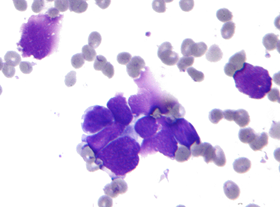
A 60 year-old male had a chest radiograph which revealed a   noncalcified smooth rounded pulmonary nodule 2 cm in diameter in the right middle lobe. A  chest film 6 years later showed no change, but after 2 more years the lesion had increased in  size to 3 cm (fig. 2). The patient was asymptomatic with negative sputum. The lesion was considered  most likely to be a granuloma. An uncomplicated transthoracic needle biopsy was  performed using the Rotex instrument. The abundant cellular material obtained (fig. 2) was  considered compatible with a bronchial adenoma. Surgical resection confirmed the biopsy  diagnosis.

Case 2
A 71-year-old woman underwent total colectomy for ulcerative colitis complicated by adenocarcinoma. Preoperative chest radiographs revealed a small  long-standing pulmonary nodule in the right lower lobe attributed to a granuloma. A chest  film 2 years later revealed a new nodule in the left lower lobe, clearly seen on whole lung   tomography (fig. 3). The provisional diagnosis included solitary metastasis, primary lung  cancer, or granuloma. An uncomplicated transthoracic needle biopsy was performed using  the Rotex instrument. Microscopy showed aggregates of malignant cells within a  background of chronic inflammatory cells. At higher power, one aggregate showed sufficient  histologic detail for a diagnosis of metastatic adenocarcinoma, probably from colon. Barium study  of the remaining gastrointestinal tract, bone scan, and excretion urography were  all unremarkable. A liver scan was equivocal, but liver biopsy and a hepatic angiogram were  normal. The left lower lobe nodule was resected and histology revealed metastatic  adenocarcinoma, most likely from colonic carcinoma.

Results
A total of 88 patients, representing all the transthoracic  biopsies done with the Rotex screw needle biopsy instrument from late 1974 to mid 1976 were  reviewed. They consisted of a highly selected group of patients with negative sputum cytology and an   undiagnosed pulmonary nodule or nodules on chest films. Twelve patients had a known   primary malignancy. In all patients tomography had failed to demonstrate "benign"   calcification. There were 10 patients with central lesions in whom bronchoscopy was negative . The size  and distribution of the malignant tumors is shown in table 1. Central lesions were those  situated in the medial two-thirds of the lung on the posteroanterior radiograph and the  middle third on the lateral radiograph. Of the 88 patients, 57 had proven malignancy. On  transthoracic biopsy, malignant cellswere obtained in 50 patients, atypical cells suspicious of  malignancy in three, and in two patients a diagnosis of bronchial adenoma was made (table 2). Two  patients developed a pneumothorax so that only one biopsy could be carried out. These  were both negative, but at thoracotomy bronchogenic carcinoma was found. Like other   investigators [30], we considered one biopsy, in the absence of malignant cells, to be a technically inadequate examination. The diagnosis was confirmed by thoracotomy in 34 patients and by  clinical course in 20 patients. Autopsies were performed in three patients. The pathologic  diagnosis was bronchogenic carcinoma in 44, metastatic malignancy in 11, and bronchial  adenoma in two patients (table 2). In one of the 12 patients with known primary malignancy,  acid-fast organisms established the presence of a tuberculoma rather than a solitary metastasis. The  other 28 patients had benign lesions (table 3). Three biopsies, each without evidence of  malignant or atypical cells, were required before the diagnosis of a benign lesion could be  considered. The most common finding (25 patients) was chronic inflammatory cells at times associated   with Langhans's giant cells (four patients). Acid-fast bacilli in three patients and  histoplas mosis in one on special stains plus thoracotomy in six of these patients established the benign  nature of the lesion. In the other 15 patients there has been no radiographic change over the last  1-2 years. Abundant fat cells obtained from one lesion suggested a lipoma; this lesion has not  changed over 18 months.
Another biopsy revealed only clotted blood, suggesting an infarct  or hematoma. This lesion resolved completely over a 4 month period. One false positive  biopsy diagnosed as adenocarcinoma was found at thoracotomy to be a histoplasmoma.  Even in retrospect, however, the cytologists considered the cells to be indistinguishable from   tumor. Overall, 21 patients were spared an exploratory thoracotomy as a result of the  negative biopsy. Finally, three additional patients with negative transthoracic biopsies have had  insufficient follow-up to confirm the benign nature of the lesions. As with conventional  fine needle aspiration biopsy, pneumothorax was the most common complication, occurring in 27  (30.7%) of our patients (table 4). Of these, 21(23.9%) were insignificant; only six  patients (6.8%) developed a pneumothorax severe enough to require a chest tube. There was a  significantly higher risk of pneumothorax in patients with central lesions and in those with  emphysema. Transient minor hemoptysis was experienced by seven patients (8%). In 12 patients (13.6%) minor alveolar hemorrhage developed around the lesion but cleared within 24-48 hr.

Discussion
The Rotex screw needle biopsy instrument has a number of  theoretical advantages over the aspiration needle [33] . Tissue along the length of the spiral  portion of the screw needle (16 mm) can be sampled, whereas with the aspiration needle, material is  obtained only from the region adjoining the needle tip. With cavitating lesions, the screw  needle tip can be located next to the outer wall of the lesion and the spiral portion then introduced so as to sample a cross section of the wall. Connective tissue as well as cellular material can be  obtained, and at times the histologic detail may be preserved in part. Representative  material from firm fibrous lesions is more likely to be obtained, and, if required, the sample can be  placed directly into culture media for bacteriologic examination. In our experience, these theoretical advantages have proved true in practice. Cytologists have commented on the abundance of  cellular material obtained compared to that with the aspiration technique. Frequently we  have obtained fibrous tissue and on a number of occasions Langhans's giant cells, which, in the  absence of tumor cells, increase the likelihood of the lesion being inflammatory in origin.  Organisms have also been obtained from granulomas, and a number of very firm pulmonary nodules and  cavitating lesions were successfully biopsied. The increase in cellular material obtained  was not accompanied by a significant increase in complications.
Unfortunately, a definite diagnosis has not been established in  three patients. Excluding these plus the two technical failures, our yield in the malignant  lesions has been very successful, with three of 55 patients suspicious for malignancy on biopsy and the  rest diagnostic on biopsy. Of the 28 benign lesions, 27 were correctly diagnosed as negative   for tumor. One false positive diagnosis of an adenocarcinoma was made, which compares with the  false positive range shown by other investigators (2.0%-3.7%) [30]. Over 75% of the tumors were peripheral, and slightly over half  were in the upper lobes. About 25% of the lesions were less than 2 cm in diameter; the rest were   mainly 2-4 cm in diameter. The location and size approximates the experience of others 123,  30].
Our overall incidence of pneumothorax (30.7%), with 6.8%   requiring a chest tube compares favorably with Sinner's report [30]. In his series of 2,726  patients, 27.2% developed a pneumothorax, and in 7.7% the pneumo thorax was significant (30].  Also our incidence of minor transient hemoptysis and minor alveolar hemorrhage following biopsy is similar to the experience of others [30].
Although our series is small, the accuracy rate to date has been  high with an acceptable complication rate. This we attribute primarily to the  effectiveness of the Rotex screw needle biopsy instrument in sampling lesions, which results in a greater   amount of representative material compared to the conventional fine needle aspiration  technique. In addition, we have found biplane fluoroscopy very useful for the accurate placement  of the needle tip within the lesion.

NB! Acknowledgments, references, tables and illustrations in the study are not shown here.
This is a reference to Am J Roentgenol 129: 215-220 August 1977.